ai-visibility
Is My Website AI Search Ready in St Petersburg, FL?
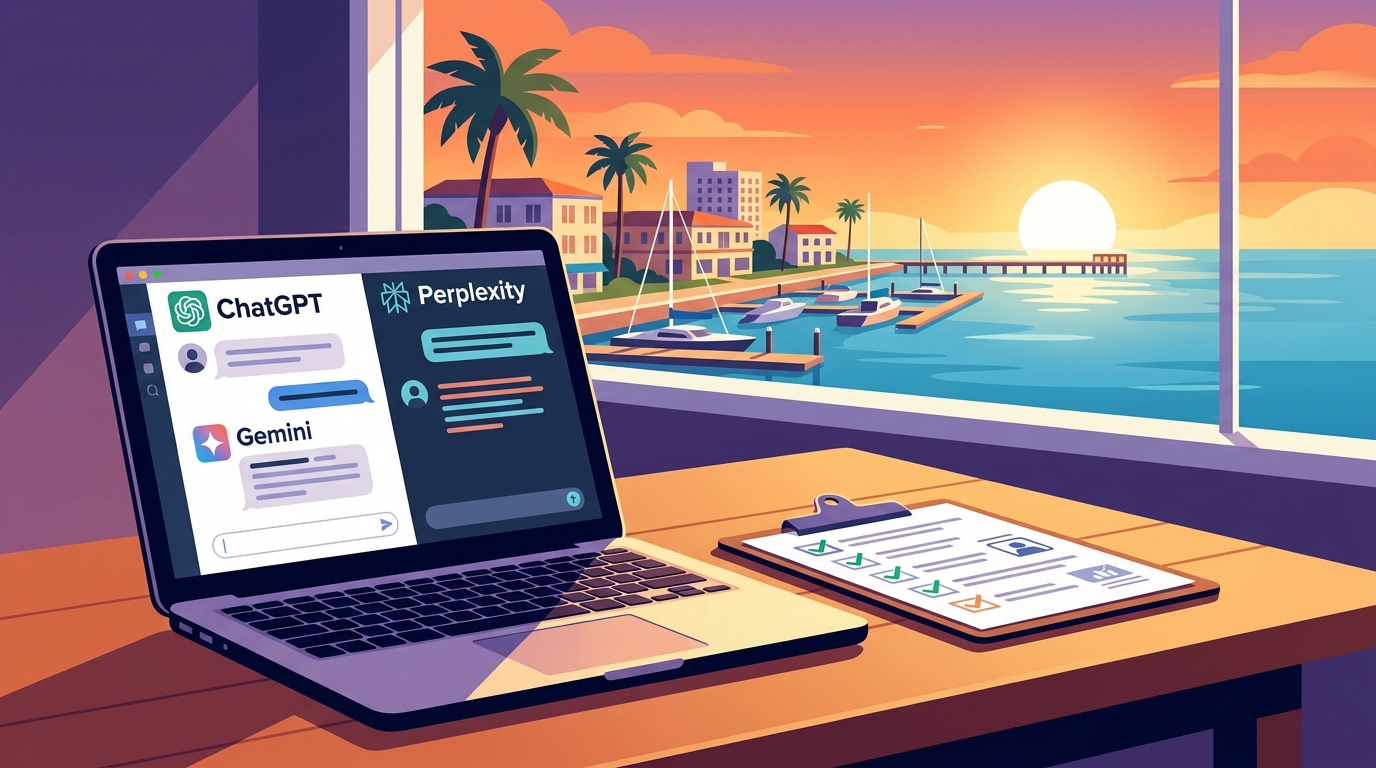
Probably not — and that's the honest answer for most St. Petersburg service businesses right now. If your site hasn't been audited for AI visibility across ChatGPT, Perplexity, Gemini, Claude, and Google's AI Overviews, you're almost certainly missing from answers your customers are already asking. Every month you wait, competitors accumulate the citations, schema, and third-party mentions that AI systems reward — and catching up gets harder.
What does "ready for AI search" actually mean in 2026?
Being ready means AI assistants can find your business, describe it accurately, and recommend it when someone asks a natural-language question like "best waterfront brunch in downtown St. Pete" or "emergency plumber near the Gateway." Readiness combines technical signals (schema, crawlability), factual consistency (hours, address, service area), and third-party evidence (reviews, directories, local press) that AI systems pull from.
Unlike traditional SEO, there is no ranking to check. AI answers are probabilistic and personalized, so "visible" means appearing in a meaningful share of relevant prompts across multiple engines — measured with documented sampling, not a single lookup.
How can you check if your business shows up in AI search results today?
Run the same questions your customers would. Open ChatGPT, Perplexity, Gemini, and Google's AI Overviews and ask 10–15 category prompts — "best [your service] in St. Petersburg," "[service] near the beaches," "[service] in Pinellas County." Log whether you're mentioned, in what position, and which sources the AI cites. If you appear in fewer than 20% of relevant answers, you have a visibility problem.
A structured audit goes further. Chat Radar's approach — and the approach any credible provider should take — documents exact prompts, sampling dates, device and location assumptions, and citation sources across engines. Answers shift daily, so a one-time screenshot isn't a measurement. Repeat testing is what turns a gut feeling into a baseline you can improve against.
The four things to log on every prompt:
- Mention rate — how often you appear at all
- Prominence — recommended early or buried mid-answer
- Citation source — which page or directory the AI is quoting
- Factual accuracy — are hours, address, and services correct
How does AI search differ from traditional SEO?
Traditional SEO gets you a blue link on a results page; AI search decides whether to mention you inside a synthesized answer, often without the user ever clicking. Google rankings reward keywords and backlinks; AI systems reward factual clarity, structured data, third-party citations, and consistent entity information across the open web. You can rank #1 on Google and still be invisible to ChatGPT.
The practical shift for St. Petersburg businesses: your Google Business Profile, your Yelp presence, your mentions in local tourism pages, your reviews on category-specific directories, and your own schema markup all feed the AI's answer. A single well-optimized landing page isn't enough. AI systems triangulate across sources, so inconsistency — a wrong phone number on one directory, an outdated service area on another — quietly disqualifies you from being recommended.
What does waiting actually cost a St. Petersburg business?
Waiting costs compound in three ways: lost referrals you never see, competitor citation gaps that widen monthly, and remediation work that gets more expensive the longer bad data sits in AI training and retrieval systems. A single-location business missing from AI answers during peak visitor season — roughly late fall through spring in St. Pete — can lose dozens of first-time-customer conversations per week.
Here's the progression:
| Delay | What happens | Typical remediation cost |
|---|---|---|
| 0–3 months | Small visibility gap; a few competitors cited more often; factual errors still fixable at the source | $750–$2,500 one-time audit |
| 3–9 months | Competitor citations harden; outdated info propagates across AI systems; reviews on rival businesses accumulate | $2,500–$7,500 audit plus implementation |
| 9–18 months | You're systematically absent from category answers; rebuilding entity signals requires content, PR, and citation work | $1,500–$5,000/month managed program |
| 18+ months | Competitors own the category in AI answers; new-customer flow measurably declines; recovery requires sustained multi-channel work | $2,500–$7,500/month comprehensive GEO/AEO |
These ranges come from industry-published pricing guides for AI visibility audits and managed AEO programs. A one-time audit runs roughly $500–$2,000 in one published guide, with implementation work reaching $2,500–$10,000 depending on scope. Self-service monitoring tools start around $15/month and climb to several hundred for broader engine coverage.
The St. Pete-specific wrinkle: hurricane season runs June 1 through November 30. If your hours, closures, or emergency instructions can't propagate to AI systems within hours of a storm, you're either turning away customers you could serve or accepting ones you can't reach. Outdated AI answers during a weather event become a consumer-protection issue, not just a marketing one.
What should be on your AI-readiness checklist?
Twelve items separate ready from not-ready. Work through them in order — the technical foundations at the top determine whether the visibility work at the bottom is worth doing.
- Crawlability and indexation — AI crawlers can reach every important page
- Structured data (schema) — LocalBusiness, Service, FAQ, and Review schema in place
- NAP consistency — name, address, phone identical across Google Business Profile, Yelp, Apple Maps, Bing Places, and every industry directory
- Service-area clarity — downtown, beaches, South St. Pete, Gateway, Pinellas County spelled out on-page
- FAQ content answering real customer questions — the exact phrasing people use in prompts
- Neighborhood and landmark references — content that distinguishes St. Pete from Tampa and Clearwater
- Mobile performance — fast load, accessible forms, clean mobile map embeds
- Review volume and recency — active review flow on Google and category platforms, no gating
- Third-party citations — mentions in local news, tourism pages, and industry directories
- Hours and closure updates — a process to push changes fast, especially during hurricane season
- Compliance-safe claims — no unsupported "best," no fabricated reviews, no undisclosed incentives (Florida's Deceptive and Unfair Trade Practices Act still applies)
- Baseline prompt monitoring — a documented set of prompts tested regularly across major AI engines
If you can honestly check eight of twelve, you're in reasonable shape and need targeted fixes. Six or fewer, and you need a structured audit before anything else.
How do you make your business visible to AI assistants once gaps are found?
Fix the factual foundations first, then build the third-party evidence AI systems use to justify a recommendation. That means correcting NAP inconsistencies across every directory, adding LocalBusiness and FAQ schema, rewriting service pages to include specific St. Pete neighborhoods and landmarks, and setting up a monthly review-generation process that stays inside FTC and Florida advertising rules.
The second layer is content that answers questions the way customers ask them. AI systems favor pages that directly address queries like "what does [service] cost in St. Petersburg" or "how long does [service] take near the beaches" — not generic service pages optimized for keyword density. FAQ sections, comparison tables, and locally specific landing pages all outperform brochure copy.
The third layer is monitoring. AI answers change; a fix that worked in March may need re-testing by September. Continuing measurement — the same prompts, sampled monthly, logged with dates — is what separates a project from a program.
When is waiting actually the right call?
Waiting is defensible in three cases: you're pre-revenue and don't yet have a defined service area, you're mid-rebrand and your name or address is about to change, or your website is being replatformed in the next 60 days and any current audit findings would be obsolete on the new site. In every other case, waiting is a decision to concede citations to competitors who aren't waiting.
One caveat worth naming honestly: AI visibility is not guaranteed. No provider — including Chat Radar — can promise you'll appear in a specific answer. What a credible engagement delivers is measurement, remediation, and improved probability across a documented prompt set. Anyone promising ranked placement in AI answers is selling something that doesn't exist.
Frequently asked questions
How much does an AI visibility audit cost for a St. Petersburg business?
For a single-location St. Petersburg business, expect roughly $750–$2,500 for a one-time audit covering prompt testing, citation review, Google Business Profile consistency, and prioritized recommendations. Audit-plus-implementation engagements run $2,500–$7,500. Ongoing monitoring programs for smaller organizations typically fall in the $1,500–$5,000 per month range, with more comprehensive multi-location programs starting around $5,000 monthly.
How is AI search different from Google search?
Google search returns a list of links; AI search returns a synthesized answer that may or may not mention your business by name, often without the user clicking through. AI systems pull from structured data, third-party citations, reviews, and directory consistency rather than backlinks and keywords alone. You can rank well on Google and still be invisible to ChatGPT, Perplexity, or Gemini.
Can I test my AI visibility myself?
Yes, for a rough read. Ask ChatGPT, Perplexity, Gemini, and Google AI Overviews 10–15 category prompts a customer would use — "best [service] in St. Petersburg," "[service] near downtown," "[service] in Pinellas County" — and log whether you appear, where, and what sources are cited. This gives you a directional baseline but not the sampling rigor of a structured audit, which documents prompts, dates, and engine variation systematically.
What Florida laws apply to AI-optimized marketing content?
Florida's Deceptive and Unfair Trade Practices Act and federal FTC advertising rules apply to AI-optimized content the same way they apply to any marketing. Fake reviews, undisclosed incentives, unsupported "best" claims, and review gating are all off-limits. Florida Statute §106.145 addresses certain generative-AI political ads but generally doesn't affect ordinary local-business AEO work. Regulated sectors — legal, medical, financial — face additional professional advertising rules.
How often should AI visibility be re-tested?
Monthly at minimum for businesses actively investing in visibility, quarterly for maintenance mode. AI answers shift as models update, as competitor content changes, and as citation sources evolve. A prompt set that showed you in 40% of answers in March may show 25% by September without any change on your end. Documented repeat measurement — same prompts, logged dates — is what makes trend data reliable.
Does hurricane season affect AI visibility work in St. Petersburg?
Yes, in two ways. First, from June 1 through November 30, your systems for updating hours, closures, and emergency instructions need to push changes fast — outdated AI answers during a storm can send customers to closed locations. Second, weather-dependent categories (contractors, restoration, lodging, insurance) see sharp demand spikes around tropical disturbances, making AI visibility more valuable exactly when accuracy is hardest to maintain.
The bottom line
Most St. Petersburg service businesses aren't ready for AI search, and the cost of finding out later is higher than the cost of finding out now. A defensible starting point is a fixed-scope audit that documents where you stand across ChatGPT, Perplexity, Gemini, Claude, and Google AI Overviews, identifies the technical and citation gaps, and gives you a prioritized remediation plan you can execute or hand off.
Readers in St. Petersburg who want this handled professionally can reach Chat Radar at https://chatradar.ai or +1 813-777-0031 to scope an AI visibility assessment for their business.