ai-visibility
How AI Platform Algorithm Changes Affect Your Visibility in Tampa
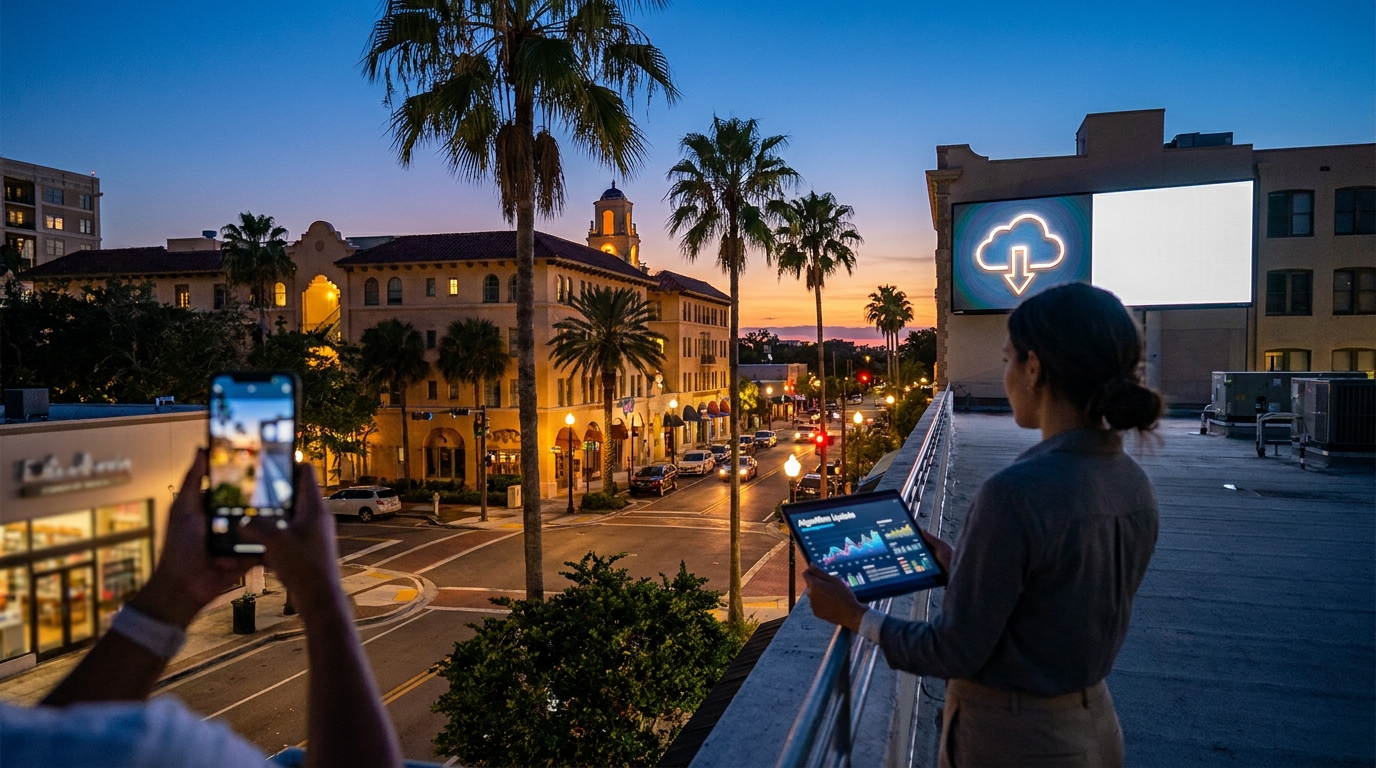
Type your business category into ChatGPT right now. Do you show up? If you don't know the answer — or worse, if you assumed your Google rankings would carry you — you're already behind. The discovery layer for Tampa businesses has shifted faster in the last six months than it did in the previous six years.
Here's what changed, why it matters for visibility in the Tampa market, and what to do about it before the next algorithm shift quietly rewrites who gets recommended.
The 2026 AI Algorithm Shifts You Can't Ignore
The short version: every major AI platform rewrote its answer behavior across 2026. The long version is more uncomfortable.
Google's AI Overviews now reach over 2.5 billion monthly users, and AI Mode has surpassed 1 billion monthly users — figures Google confirmed at Google I/O 2026. AI Mode queries are growing more than 2× per quarter. If a prospect in Westshore asks Google about marketing technology vendors, what they see first is no longer ten blue links. It's a generated answer that may or may not mention you.
Then there's ChatGPT Shopping. Feed-integrated product recommendations surged from roughly 8% to over 61% of tracked product recommendations by July 2026, according to analysis of approximately 1.76 million tracked prompt runs. By early September, feed retrieval accounted for approximately 65% of tracked product recommendations. Whether your brand gets surfaced depends entirely on whether your product data is in the right feeds — not just whether ChatGPT was already citing you.
Different AI engines apply different retrieval logic — some favor structured, factual clarity while others weight credibility and authoritative voice. Copilot and Perplexity each operate with distinct citation behavior.
Different engines. Different retrieval logic. Different citation behavior. The conventional SEO playbook is now materially less effective.
Why This Hits Tampa Businesses Harder Than You'd Think
Tampa's economy is heavily weighted toward services that depend on local discovery — professional services around the Westshore business district, healthcare around the USF and Tampa General corridor, hospitality and tourism along the Riverwalk, and a fast-growing tech and marketing scene in Channelside and Ybor.
When AI interfaces now dominate product and service discovery queries, that's a structural change in how Tampa buyers find you. A marketing director in South Tampa evaluating vendors no longer types "marketing technology consultant near me" and scrolls. They ask Copilot, Gemini, or ChatGPT for a recommendation — and they trust the synthesized answer. Pew Research data shows traditional result click rates drop to 8% when AI Overviews appear, versus 15% without them. That gap compounds every time a prospect searches.
There's also a seasonal wrinkle unique to this market. Snowbird season concentrates buying decisions between November and April, and hurricane season pushes service-industry queries into tight windows around June through November. If your AI visibility collapses in October, you don't find out until December — when the lost pipeline is irreversible.
What Changed Inside Each Engine
Google AI Mode and AI Overviews
Google now provides native Search Console reporting for AI Overviews, AI Mode, and AI features in Discover — covering impressions, pages, countries, and devices, with data going back to May 18, 2026. As of August 31, 2026, Google completed worldwide rollout of generative-AI impression reporting and AI-feature opt-out controls. Opting out removes a site from AI answers but does not affect ordinary rankings, according to Google. There's an additional wrinkle confirmed in late August: AI Overviews can now dynamically expand into full AI Mode-style answers for some queries without user interaction, automatically pushing traditional organic results further down the page. Google is also testing side-panel placements for some hotel searches. The takeaway: Google is running AI surfaces as an expanding system that increasingly displaces traditional organic results.
ChatGPT
ChatGPT Shopping's pivot to feed-based product retrieval is the defining shift of the second half of 2026. Citation position is now directly tied to feed integration and brand-model associations — brands without established category associations in ChatGPT's retrieval logic see dramatically reduced recommendation rates. There's no consolation prize for being absent from the feed.
Perplexity
Perplexity remains the most citation-transparent of the major engines, which is both an opportunity and a trap. You can see exactly which sources it pulls from, but its retrieval logic shifts often — patterns that reward one content format can change with a single model update. Only 11% of domains are reportedly cited by both ChatGPT and Perplexity, confirming these operate as distinct ecosystems rather than a unified channel.
Microsoft Copilot
Copilot's expansion through browser-integrated assistants has turned search into a layer of interpretation between users and the open web. That's a polite way of saying: Copilot decides what your prospect sees about you before they ever visit your site.
How to Measure AI Visibility (Because Rankings No Longer Tell You)
The core question in 2026 is not where you rank on Google, but whether you appear inside generated answers at all. Google's Search Console now reports AI impressions — but not clicks or queries — making direct ROI measurement from AI appearances difficult. Dedicated AI visibility platforms exist specifically to fill that gap.
What you should be tracking now:
- Citation frequency — how often each AI engine references your brand in answers to category-relevant queries
- Position prominence — where in the answer your mention lands (first paragraph vs. footnote)
- Per-engine variance — your ChatGPT visibility tells you almost nothing about your Perplexity visibility
- Query coverage — which Tampa-specific queries trigger your inclusion at all
What to Actually Do About It
Per-engine visibility strategies are not optional anymore. Here's the practical framework for auditing Tampa marketing technology operations:
- Run a baseline audit across all six major surfaces — ChatGPT, Perplexity, Copilot, Gemini, Claude, and Google AI Mode — for your top 25 category queries.
- Separate AEO content from GEO content. AEO assets need structured, factual clarity. GEO assets need authoritative point-of-view and citations from credible third parties.
- Build out location-anchored content. AI engines disambiguate Tampa from Tampa-area vendors using consistent local signals — neighborhood references, Hillsborough County context, and verifiable local entity associations.
- Coordinate paid and organic inside AI Mode. Google's AI surfaces are a distinct channel that determines whether you appear inside AI-generated answers, separate from traditional organic rankings.
- Ensure product feed integrity. ChatGPT Shopping's shift to feed-based retrieval means structured product and service data must be accurate, complete, and indexed correctly — this is now a direct input to recommendation visibility.
- Re-audit monthly. Major retrieval changes across platforms have happened with little or no advance warning throughout 2026. The next one will too.
FAQ: AI Algorithm Changes and Local Visibility
Is traditional SEO dead for Tampa businesses?
No, but it's no longer sufficient. Traditional rankings still feed many AI retrieval systems as a signal, but ranking #1 on Google doesn't guarantee citation inside an AI answer. Treat SEO as a foundation and GEO/AEO as the new performance layer on top.
How often are AI algorithms changing in 2026?
Materially, every few weeks. Google's August 2026 Spam Update targeted low-quality and scaled AI-generated content and completed in days. The ChatGPT Shopping feed shift happened rapidly, with the surge recorded in July 2026. Smaller retrieval and citation adjustments happen continuously across all six major engines.
Do AI engines treat Tampa businesses differently than national brands?
Yes — location-anchored authority signals matter more for local queries. A Tampa-specific query will favor entities with consistent local citations, verifiable geographic associations, and content that demonstrates familiarity with the market.
Why does AI visibility vary so much between ChatGPT and Perplexity?
Each platform uses different retrieval logic, citation behavior, and source weighting. Internal ranking formulas remain proprietary, and research shows only about 11% of domains are cited by both platforms — so per-engine measurement is the only reliable way to know where you stand.
What does Google's AI Search Console reporting actually tell me?
As of August 2026, Google's Search Console provides impressions data for AI Overviews, AI Mode, and AI features in Discover — covering pages, countries, devices, and dates back to mid-May 2026. It does not currently report clicks or queries, which makes direct ROI measurement from AI appearances difficult. Think of it as a visibility signal, not a conversion report.
Should Tampa businesses opt out of Google's AI Overviews?
Probably not without careful consideration. Google confirmed that opting out removes your site from AI answers but does not affect ordinary organic rankings. Given that AI Overviews appear in roughly 39% of U.S. desktop searches and the share containing external links has risen above 25%, opting out means forfeiting a growing citation channel. Test your current AI impression data in Search Console before making that call.
The Bottom Line for Tampa
The Tampa businesses that adapt now will be the ones AI engines recommend through the next snowbird cycle and the next hurricane season's service queries. The ones that wait will find out — too late — that their pipeline quietly migrated to whoever showed up inside the answer box.
If you want this handled by a team that lives inside the AI visibility problem every day, Chat Radar (https://chatradar.ai) works with Tampa marketing technology operators on per-engine AI visibility audits, GEO and AEO content strategy, and the kind of monthly re-auditing the 2026 environment now demands. Contact Chat Radar at 4417 W Kensington Ave, Tampa, FL 33629 or call +1 813-777-0031 — a short conversation is usually enough to tell whether your current visibility is solid, quietly eroding, or already gone.
"